
Sometimes, leaders come to me because they’re looking for a subtle shift, a little space to notice what’s happening in their work and their relationships. They’re capable, high-performing, and strategic. And yet, they know there’s something missing. They want guidance that includes the lens of relationships and psychology, so they can navigate conflict, influence others, and grow… not just in their work, but in all areas of life.
Over my 14 years working with leaders, entrepreneurs, and founders, I’ve noticed that the challenges they bring are rarely technical. They’re relational. Subtle positioning, complex internal dynamics, misunderstandings between capable people, and the ongoing dance of influence and politics quietly shape trust, decisions, and collaboration. And these patterns don’t stay at work; they ripple outward, affecting family, friends, and the communities we care about. Helping leaders bridge that gap has always been at the heart of my work, and it’s a thread I’ve loved following with entrepreneurs, founders, and executives alike.
Relational intelligence is often thought of as a “soft skill,” but it’s anything but soft. It’s a secret superpower in leadership. When leaders begin to notice themselves and others more clearly, shifts happen: conversations that once felt tense begin to flow, the tension in the body and mind becomes something we can notice and work with, and relationships grow stronger, grounded in trust and understanding.
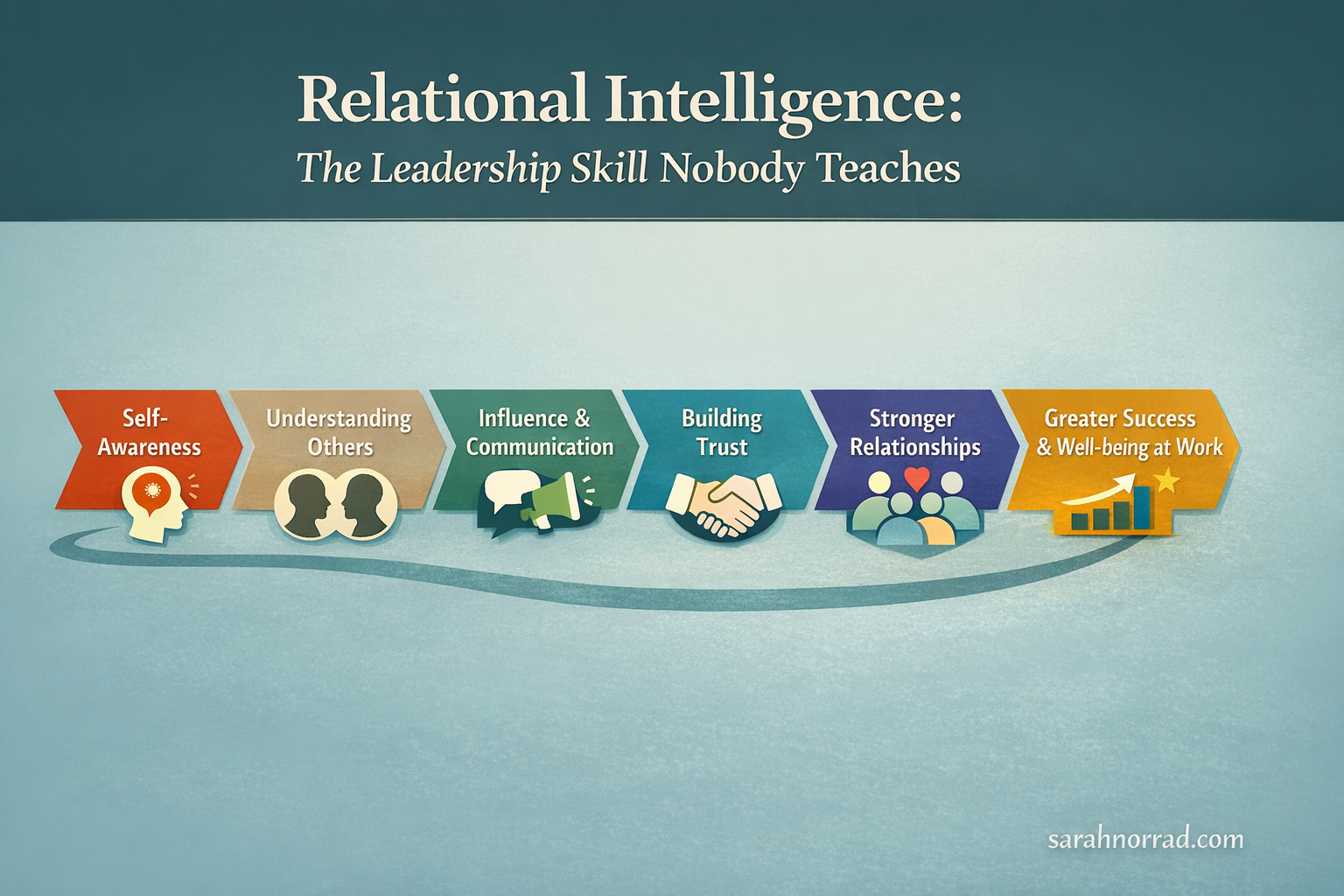
This visual highlights the pathway of relational intelligence: Self-awareness → Understanding Others → Influence & Communication → Building Trust → Stronger Relationships → Greater Success & Well-being at Work. It’s a map for seeing how subtle shifts in awareness ripple outward.
One simple way to start practicing relational intelligence is to notice patterns in how you respond under stress. Do you get more anxious, more aggressive, or withdraw? And then, gently experiment with responding in ways that invite openness, curiosity, and engagement, rather than shutting down or creating conflict. It doesn’t have to be perfect, just noticing and experimenting is where the learning begins.
Relational intelligence ripples outward. It transforms not only how we lead at work but also how we show up for the people we care about. And that ripple is what makes this skill so quietly powerful and so profoundly rewarding to cultivate.
*Copyright Sarah Norrad 2024 - all rights reserved
If this blog has inspired you, or if you are interested to work with me I would be honoured to connect with you: